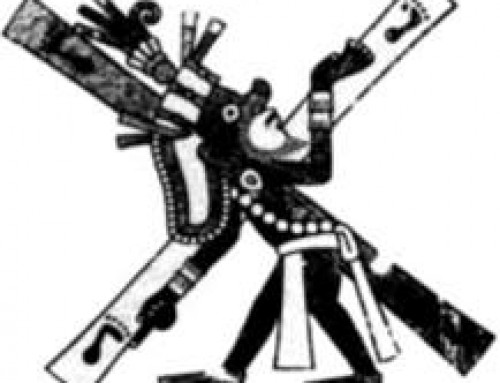
The Mesoamerican god Quetzalcoatl (the feathered serpent) on the cross, vast distances away from Israel where Jesus was crucified.
~ Copyright 2012 Belsebuub and Angela Pritchard
The spring equinox (also known as the vernal equinox) is a spiritual time found in ancient sacred sites and teachings throughout the world. Its deeper spiritual significance reveals the mysteries of spiritual resurrection.
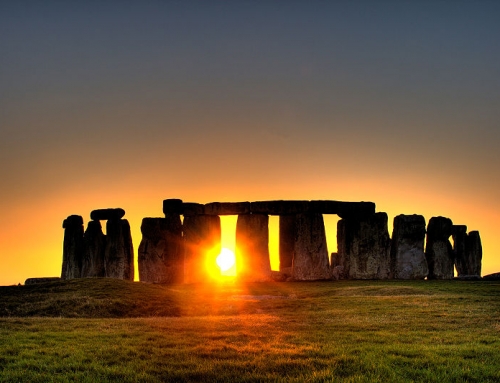
In Christianity, the spring equinox is the time of the passion, crucifixion, and resurrection of Jesus. Likewise in ancient Egypt, it is the time of the resurrection of the ancient Egyptian god Osiris; and in Mesoamerica, the resurrection of the Maize God Hun Hunahpu. The Great Sphinx of Giza, in Egypt, symbol of resurrection, gazes precisely at the rising of the spring equinox sun. The temple of Angkor Wat in Cambodia aligns to the spring equinox, and depicts the scene of the “churning of the milk” – the struggle between the forces of light and darkness. At the temple of the feathered serpent in Mexico at Chichen Itza, the feathered serpent Quetzalcoatl ascends the 9 terraces of the pyramid, on the spring equinox.
Throughout the world, the spring equinox is a time of great confrontation between the forces of darkness and light, in the death and resurrection of the central deities of sacred teachings throughout the world. It symbolizes what an initiate goes through in a definitive and important stage of self-realization, where the struggle between darkness and light creates the opposition needed to attain immortality. This is symbolized by the dark half of the year on one side of the spring equinox sun, and the light half of the year on the other.
The Deeper Significance of the Cycle of the Sun

Medieval painting of Christ at the center of the zodiac as the sun
The spring equinox is the time in the earth’s annual cycle around the sun in which day and night are equal in length, before the days finally start to get longer after the dominance of darkness during winter, and life springs forth from death.
The sun’s visual journey throughout the course of the year signifies a universal journey, which has been understood and undertaken by people throughout the world, and throughout time—the journey to enlightenment. This is why the lives of Jesus, Osiris, Tammuz, Hun Hunahpu, Dionysus, and many others, match the cycle of the sun. Each of these deities revealed the process of reaching enlightenment in the events of their lives, just as the cosmos reveals it each year in the path of the sun, and why the lives of these deities share so many similarities. Creation is imbued with the very truths of the deeper purpose of life. This is also why ancient sacred sites and teachings integrated the movements of the sun and stars, symbols of nature, and sacred principles of mathematics, into their temples and texts.
Like the sun, at the autumn equinox, the initiate must descend into the underworld to face their own inner darkness and overcome it. At the winter solstice, the Son (the Christ/sun) is born within the initiate. At the spring equinox, the Son is betrayed, dies, and is resurrected to attain eternal life. And at the summer solstice, the height of light, the Son ascends to return to the divine source.
The Sun Christ
In the wheel of the year, the sun is the Christ, the Son, the universal spiritual force which merges with a person doing the spiritual work once they have reached an advanced spiritual level. The Christ is not unique to Christianity—Jesus portrayed the work of the Christ in his life, just as Osiris, Krishna, Mithras, and Tammuz did thousands of years earlier, and Quetzalcoatl and Hun Hunahpu did vast distances away.
Central to their lives was their own betrayal, death, and resurrection, which occurred on or was associated with the time of the spring equinox. Through their lives they portrayed what an initiate goes through to reach what has been called salvation, eternal life, enlightenment, self-realization, immortality, imperishability, awakening, liberation, etc., and what someone still goes through to reach this today.
The Great Struggle Between Light and Darkness in the Churning of the Milky Ocean

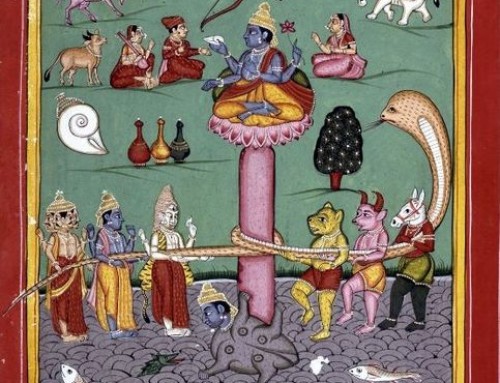
Painting of the famous scene of the churning of the milky ocean. All the treasures that have emerged from the ocean surround Vishnu, sitting atop the lotus.
The spring equinox stands upon the point of balance, upon which everything pivots in its motion, in the universe, in the cycles of the seasons, and within ourselves. On one side of the equinox is the dark half of the year, and on the other the light half, representing the struggle between the forces of darkness and light. It is this struggle that gives motion to all cycles in the universe, and which is likewise found in the spiritual work to awaken. This is why Jesus, Osiris, Quetzalcoatl, etc., faced their greatest struggle against darkness to attain the light at the spring equinox.
This universal principle is illustrated at the temple of Angkor Wat in Cambodia, which aligns to the spring equinox. It portrays the ancient sacred Hindu teaching from the epic the Mahabharata of the churning of the milky ocean in a giant representation on its walls, and in the design of its temple complex which incorporates the sun and the stars as celestial counterparts of the story.
The story of the churning of the milky ocean, as explained below, shows the fundamental principles that underpin the cycles of the sun throughout the seasons, the cycle of our earth through what is called the precession of the equinoxes, the turn of the Wheel of Samsara, the cycles of humanity called Yugas, and the inner spiritual process called resurrection.
The Churning of the Milky Ocean

The central segment of the mural of the churning of the milky ocean at Angkor Wat. Vishnu is the large central figure – above him is Indra, below him the turtle in the ocean, and on either side the demons and devas pulling (photo copyright wiki user Markalexander100 2005).
The giant stone mural of the churning of the milky ocean at Angkor Wat depicts the asuras (demons) and devas (angels) as being in a tug of war. They each hold one end of a massive serpent, which is wrapped around a sacred mountain, balanced on a turtle swimming in the great milky ocean. As the demons and devas pull back and forth, they rotate the mountain which churns the milky ocean below. The god Vishnu stands at the mountain, which is the point of rotation and the god Indra is above in the sky.
The story is also depicted through the design of the temple itself and its alignment to the sun and stars. On the spring equinox, the sun rises to crown the pinnacle of the main tower of Angkor Wat, which is symbolic of Mount Meru, home of the gods—representing Indra (as the sun) rising into the sky to return to his abode as the King of Heaven. In 10,500 BC Angkor Wat and a number of surrounding temples aligned to the constellation Draco, which is the celestial depiction of the great serpent wrapped around the mountain.
The Cycle of the Sun
There are 91 demons to the left, which are the days between the winter solstice and the spring equinox, and 88 devas to the right who are joined by Vishnu, Indra, and Kurma (the turtle incarnation of Vishnu), which are the days between the spring equinox and summer solstice. The point of balance is the spring equinox. The pull of the serpent towards the demons, and then back towards the devas, symbolizes the movement of the sun (represented by Vishnu) into the dark half of the year, to reach the extreme of the darkest day on the winter solstice, then returning until crossing the point of rotation (the equinox) to travel towards the opposite extreme of the longest day on the summer solstice, and back again.
The Precession of the Equinoxes
On a broader cosmic scale, the design of the mural also encodes the numbers of the precession of our earth through the constellations, referred to as the precession of the equinoxes. Approximately every 2,150 years the sun on the spring equinox rises in a different constellation, and an entire cycle throughout all the constellations takes approximately 26,000 years. Like in the annual cycle of the sun, in this cycle also, the spring equinox is the point of rotation.
The Wheel of Samsara and Yugas

Buddhist painting of the Wheel of Samsara. Notice the light and dark halves of the middle of the wheel, which all life rotates through.
In encoding the numbers of precession, the mural also contains the sacred numbers of the cycles of human life. Whilst the annual solar cycle depicts the journey to enlightenment in one lifetime, the cycle of precession contains the number 108—a number sacred in Hinduism and Buddhism. 108 is the number of human incarnations a person has in one turn of the Wheel of Samsara. Like the dark and light half of the year found in the change of seasons from summer to spring, the Wheel of Samsara also has its periods of light and darkness. As the wheel rotates up it is in light, called evolution, and as it rotates down, it is in darkness, called devolution. Within the Wheel of Samsara is found the progress of the person through the cycles of life, with the forces of light urging the person to awaken, and the forces of darkness, dragging the person into the abyss. This same rotation is found in the cycles of humanity known as Yugas, which were also encoded in the temple of Angkor Wat—whole civilizations and periods of human existence go through periods of light and progress, as well as darkness and degeneration.
The Struggle in the Individual and in the World
This pulling back and forth between light and darkness symbolizes an underpinning universal principle in creation, found in the cycles of cosmic time and human life. It reveals the role of darkness and light in creating movement through its struggle and opposition. But this also shows the role of darkness and light within ourselves and our lives.
This same struggle between the forces of good and evil takes place within the world, even though most people are completely unaware of it. In life, one is either taking part in this struggle or they are simply the unconscious victims of it. If one is in the struggle, they are either fighting for light, or for darkness. Those who do neither, who do not fight, who do not struggle against darkness, are simply the creatures of the ocean of existence that become churned to pieces from the churning the struggle produces.
The Treasures
In the churning of the milky ocean, the struggle between darkness and light causes multiple spiritual treasures to emerge from the ocean, a poison that has the power to destroy the universe, and finally produces Amrita—the nectar of immortality. Without the opposition that darkness brings, there would be no movement and no struggle, and it is from the struggle that the spiritual treasures are produced. The spiritual treasures symbolize the spiritual faculties and virtues which the initiate gains through their struggle against darkness.
The Poison

Shiva at the top of the churning of the milky ocean, swallowing the poison. Beneath him various treasures emerge from the ocean (photo copyright elishams 2006).
The poison that the churning produces is called Kalakuta – it is so terrible that it threatens to destroy creation. Before the nectar can be recovered in the story, this terrible poison must be dealt with first.
The opposition found in life not only brings out the best in people, but also the very worst and thus opposition also creates poison.
As this is a core principle it works on many levels, in society for example poison emerges as negative actions and psychological reactions, in alchemy as lustful desire, and within the individual as the responses of the many subconscious states and the actions that result from these states.
It could be said that the act of churning brings out the poison, and therefore separates it from the nectar. The ocean is life, the human psyche, and all of creation, and to have the poison extracted from it and separated from the nectar is of great value.
The poison within, all the hatred, violence and greed etc. is brought forth from the struggle both within the individual and externally within the world. The strength of the egos (emotions such as anger, hatred etc.) stirred up is so great that it threatens to destroy everything that is good within and the world.
For someone doing the spiritual work, when the psyche is churned by the agitation created by opposition, they get to see what is really within them – all the egos (subconscious states) that were previously hidden beneath the surface of the ocean, but which can now be extracted and destroyed. Also, when the events of life are churned, those who are of the ego are separated from those who are for good. The opposition gives rise to the land of action, where knowledge is found and intelligent deeds can be made.
In the story of the churning of the milky ocean, the devas have to ask for help to be saved from the poison. The god Shiva comes forth and swallows the poison as an act of self-sacrifice to save creation and allow the churning to continue.
The divine help which Shiva symbolizes comes to deal with the poison on different levels. In the individual, they must ask for divine help so that their own egos which are stirred up in the churning are destroyed. In the events in the world, the person of higher consciousness who sees and understands the terrible consequences of the egos of others takes it upon themselves to bear their ill effects in an act of self-sacrifice in their lives, which they do for the good of the world. And in the higher dimensions, it is the gods who mitigate the ill effects of the poison in their influence over the events of life, so that the evil of the human psyche is stopped from destroying everything.
Even though Shiva swallowed the poison, his wife stops the poison from traveling past his throat. This is the intervention of the Mother of the universe, who protects us and the whole of creation from being ultimately destroyed by the egos.
The Nectar
Finally the nectar, the positive results of the struggle emerge. Out of opposition comes the nectar of knowledge, understanding, wisdom, information, right action, good events, and what is of value in life to those who are working for greater consciousness.
In alchemy the elixir of immortality arises – that which the devas set out to achieve in the churning, which grants resurrection.
This struggle to acquire the nectar shows the important role that darkness plays in the awakening of the individual. It is in the opposition to darkness that one is tested, one develops strength, self-knowledge, will, wisdom, and many other qualities, and why before Jesus, Osiris, Quetzalcoatl, Attis, Tammuz, etc., resurrect and attain eternal life at the spring equinox, they must firstly face darkness as the betrayal, crucifixion, and death. Jesus, like Shiva, had to bear the worst of human behavior in an act of self-sacrifice, so that evil could be brought out and exposed for the good of humanity.
The Role of Spiritual Help
Whilst the demons are greater in number than the devas, the devas numbers are made up by the gods Vishnu, Indra, and Kurma, revealing that those who fight for good whilst appearing weaker in the world, are helped by the spirit, and those with the spirit, always win.
The demons try to steal the nectar of immortality using cunning and deceit, but fall before sexual desire as they are distracted by an attractive woman. Instead, through the help of the god Vishnu, the elixir is consumed by the devas which gives them the strength to defeat the demons, and allows Indra (the initiate with the Son within) to return to his abode as the King of Heaven. This is symbolic of the resurrection of the Son. In the story, the defeat of the demons was only possible through Vishnu’s intervention, and thus without Vishnu’s help, Indra would not have been able to return to heaven.
This reveals that the forces of evil in creation, within ourselves, and in the world, would always dominate those of good through the use of cunning and deceit, if it wasn’t for spiritual help. Jesus, Osiris, Krishna, and Hun Hunahpu, are all killed through deceit and betrayal. But as Jesus said, without the will of his Father, he would never have been betrayed and handed over to death in the first place. It is the spirit that allows darkness its place in creation because of the opposition it provides. Vishnu promised the devas that they would have the nectar from the beginning, but that they had to first churn the ocean alongside the demons to acquire it.
“Do you refuse to speak to me?” Pilate said. “Don’t you realize I have power either to free you or to crucify you?”
Jesus answered, “You would have no power over me if it were not given to you from above.”
The Necessity of Darkness

Painting of the Maize God Hun Hunaphu resurrecting from the turtle
The forces of darkness, evil, death, and decay, are found throughout all of creation, in our lives, and within ourselves, as well as the forces of light, goodness, birth, and growth. All form that we see is made perceptible through the combination of both light and shadow—if there were only darkness, or only light, we could not see. Dark and light both form a necessary part of creation, and also a necessary part of the spiritual work.
In the spiritual work, the initiate fights against the darkness within themselves and in the world, so that the light of the spirit triumphs within them. This great struggle was depicted in the life of Jesus, Osiris, Krishna, Hun Hunahpu, and many others, at the time of the spring equinox—symbolic of the battle between light and darkness.
Many teachings and philosophies today however, wish to focus only on the positive and the “feel good”. Darkness and evil is either ignored or worse, embraced. When what “feels good” is used as the measure for what is spiritual, then there is an avoidance of the truth and superficial beliefs are created on the whims of feelings and emotions. Thus, things like hell, which have been taught about in all great sacred teachings since ancient times, are virtually a subject of taboo. Religions on the other hand, have turned what were esoteric teachings intended for individuals to use to attain the divine, into idols of worship, dogma, and beliefs.
Between the commercial gurus of today and the world’s religions, the knowledge of the processes involved in spiritual awakening and human existence is virtually lost. However, the real esoteric knowledge is still here today, and going back into the original esoteric teachings and the understanding of the cosmos and creation, one can see it has also been given throughout history.
The attainment of spirituality is not done as some today would suggest—simply by realizing it; nor is it done simply through a belief and the death of the physical body, as many religions teach. The spirit within, which gives eternal life, is reached only by those who are prepared to go through great trials, tests, and suffering—to give up all earthly pleasures, riches, fame, etc., for the treasures of the spirit which are everlasting. This is demonstrated in the teachings of betrayal, death, and resurrection, found throughout the world, which an initiate must pass through.
The Traps

The Jews Took Up Rocks to Stone Jesus by James Tissot
In order for everything that occurs at the betrayal and death to unfold, and thus the resurrection, a series of traps must be laid to ensnare the initiate. These ensure that the necessary circumstances in the life of the initiate will occur—they are set by both the forces of evil, who always oppose those who wish to awaken, and also by the divine beings, who move the circumstances and people in the initiate’s life for them to be tested.
Keeping a close watch on him, they [the Pharisees] sent spies, who pretended to be sincere. They hoped to catch Jesus in something he said, so that they might hand him over to the power and authority of the governor.
~ Luke 20:20Then the Pharisees went out and laid plans to trap him [Jesus] in his words.
~ Matthew 22:15
In the life of Jesus and Osiris, traps are set for them by plotting people who use cunning and deceit in order to kill them. The Lords of Xibalba (of death and darkness), kill Hun Hunahpu using cunning and deceit. Osiris’ jealous brother, Seth, makes a coffin and tricks Osiris into lying in it to see if he will fit, then sealing it shut once Osiris is inside with molten metal so Osiris can’t get out. In the life of Jesus, the Pharisees, the religious authorities, conspire to trap Jesus from early on and he is betrayed through deceit. In the churning of the milky ocean, the demons steal the elixir of immortality using deceit.
These are the traps set by the people of the world who oppose the Son. The force of the Son is love. It comes into the world through a spiritually prepared person, and each time it does, hatred rises to meet it. Inevitably, the initiate who has the Son within, has to face the hatred and evil of the world.
It is not as people think—the Son doesn’t come to affirm people’s own ideas and beliefs, but challenges the evil that lies veiled within morality, the law, the human being, and society, and in doing so becomes an obstacle to people fulfilling their desires, egos, pleasures, lusts, violence, and domination. Osiris was a good king who ruled with love and justice, but Seth was jealous and wanted to rule in his place. Jesus came to give the message of divine truth, but the established religion saw him as a threat to their power.
[Jesus said] This is the verdict: Light has come into the world, but people loved darkness instead of light because their deeds were evil. Everyone who does evil hates the light, and will not come into the light for fear that their deeds will be exposed. But whoever lives by the truth comes into the light, so that it may be seen plainly that what they have done has been done in the sight of God.
~ John 3:19-21
Those in society, who appear to be spiritual, moral, religious, sanctified, and righteous, are revealed for what they are—as the light of the Son shines in the darkness of the world, it inevitably exposes their true nature. Those in the world who are full of hate come to attack the Son because their vibration is of hatred, and darkness, and they cannot stand the emanations of light and love, nor their deeds being exposed. Evil does its work in the cover of darkness. One by one, as they come out to attack the Son/Christ, their own inner evil is revealed (see The Light of Christ). In what is about to unfold, all the people around the Son, even society and the world itself, will be defined. It is only through the interaction of both light and dark that we can see. The Son is fire, is light, just as the sun, and shines into the darkness.
In this stage the initiate is caught by a multitude of traps, set by both demons and the divine law—from which there is no escape, and which came at no fault of their own. The spiritual path is set by the spirit, and so they make sure the initiate is caught in traps so that they will go through the required stage. They must go through the betrayal, an excruciating stage in which they are handed over to people who hate them, who ruthlessly destroy their image and reputation with lies and falsity.
Betrayal

Judas leaving the last supper to betray Jesus
The Christ, the Son, is always betrayed and handed over to the people in the world that hate him; evil always uses deceit to destroy good in the world. For Osiris, he was betrayed by his brother—someone who was a trusted part of his family; and for Jesus, it was his disciple Judas, someone he taught and shared his life with, who handed him over to the Pharisees.
Joan of Arc had the Son/Christ within and was born on earth with a mission. She had attained a certain stage of the spiritual work, and as part of her mission came here to complete a part of it—that stage was the betrayal. In her life she was betrayed by the King of France, the very person whom she had helped to put on the throne, and was handed over by him to her enemies the English who took her prisoner and put her on trial.
Krishna was killed by the arrows of a person whom he had revealed the crimes of. In revenge this traitor, knowing Krishna would be at the river at a certain time, came to assassinate him with a troop they had gathered together. Likewise, Judas brought a group of soldiers to Jesus, and Seth had 72 conspirators—these are the people who hate the initiate, the Son, and have been looking for an opportunity to attack.
In the Garden of Gethsemane as Jesus prays knowing that people are plotting against him, the disciples sleep, signifying that their consciousness is asleep and thus how they are unaware of what is taking place.
[Jesus says] My Father! If it is possible, let this cup pass from Me. Yet not as I will, but as You will.
~ Matthew 26:39
The initiate’s faith in the divine is tested, as all the authorities of the world will turn against them and those who they thought were with them, will desert them completely. When Jesus is seized, the disciples flee. All the students of the initiate, who like Peter, even declare they will do anything for Jesus, when the time comes to stand by their teacher, hide and deny that they even know them in fear of being attacked themselves. Apart from a few disciples, Jesus’ mother, and Mary Magdalene, the crowds who once massed around Jesus crying “Hosanna!” completely abandon him. Weak, vulnerable, and almost completely alone, the initiate must face the condemnation, insults, and scourging of the world.
The Divine Role of Judas

Judas betrays Jesus with a kiss, and hands him over to the soldiers
Jesus was someone already awakened who was born on earth with a mission—to give the universal teaching of spirituality anew both in what he taught and through the events of his life. Those around him, both consciously and unconsciously, played a role in Jesus’ life that would help to demonstrate this teaching. Judas was given the most difficult role by Jesus as his most advanced disciple (see The Gospel of Judas, and The Flight of the Feathered Serpent).
Judas symbolizes the traitor which exists within every human being, and who betrays the force of the Son—all the love, wisdom, happiness, treasures, and riches of the spirit—in return for 30 pieces of silver. The silver is symbolic of the pleasures, riches, and desires of the egos, and the material world, which are spent in passing to leave someone at the end of their life with nothing but a sickening remorse and the consequences of their actions.
The symbol of Judas hanging himself signifies the student/disciple who betrays the initiate with the Son within, as well as on a more personal level, the initiates who having the Son within, exchange him for pleasures of the world, which can happen at different times and in different ways. As they hang, their feet do not touch the ground because they can no longer enjoy the ignorant pleasure of mundane life. Nor does their head reach through heaven, because they rejected and betrayed the spirit. Instead, they are left suspended, without the happiness of a material nor spiritual life.
Judas also represents the force of desire within the psyche, which through self-deceit, betrays all that is good within a person. Through what appears as a harmless desire, the person is handed over to all the evil inside, sliding into the vices of the egos and the world, losing the spiritual within as they exchange it for the behavior that pleasures lead to. Esoterically, the work of Judas is the work to destroy the egos, and it is at this time that the initiate must carry out this work in order to reach the inner death necessary to resurrect.
Trial

Joan of Arc is interrogated in prison
Defenseless, the initiate is symbolically taken captive and treated as a criminal after everything they have done to help people. Joan of Arc who was the savior of a nation, was handed over and kept as a common prisoner, almost completely abandoned at the time of her greatest need by all those who had followed her on the battlefield, except for a handful of loyal comrades.
The members of Jesus’ own religion sought to destroy him by finding him guilty before the authorities of the day. It was Osiris’ own brother and members of his own court that conspired against him. And for Joan of Arc, it was her own King and country that gave her over to the English.
Jesus is left defenseless, at the mercy of those who hate the Christ, and remains silent at the false accusations made against him to signify how the initiate is made unable to defend themselves during this time. Like Osiris who was sealed in the coffin, the initiate is left completely trapped, unable to defend themselves in the face of their own demise. All those who they knew and helped, instead emerge to give false testimony against them.
The chief priests and the whole Sanhedrin were looking for evidence against Jesus so that they could put him to death, but they did not find any. Many testified falsely against him, but their statements did not agree.
Then some stood up and gave this false testimony against him: “We heard him say, ‘I will destroy this temple made with human hands and in three days will build another, not made with hands.’” Yet even then their testimony did not agree.
Then the high priest stood up before them and asked Jesus, “Are you not going to answer? What is this testimony that these men are bringing against you?” But Jesus remained silent and gave no answer. Again the high priest asked him, “Are you the Messiah, the Son of the Blessed One?”
“I am,” said Jesus. “And you will see the Son of Man sitting at the right hand of the Mighty One and coming on the clouds of heaven.”
The high priest tore his clothes. “Why do we need any more witnesses?” he asked. “You have heard the blasphemy. What do you think?”
They all condemned him as worthy of death. Then some began to spit at him; they blindfolded him, struck him with their fists, and said, “Prophesy!” And the guards took him and beat him.
~ Mark 14:55-64

Jesus before Pilate
Both Jesus and Joan of Arc are treated as criminals and put on trial by the religious establishment. The initiate must be rejected by their own religion, and in rejecting the Christ/Son (the real source of spirituality in the world), the religion defines itself as that which opposes the Son no matter what they preach.
The religious Pharisees are unable to find any charge against Jesus or Joan as they did no wrong, despite all the false evidence. However, both are finally accused of blasphemy/heresy (today it is cult-leader or heretic) as they dared to declare their relationship with divinity, which they had only done for the good of helping others. The Son comes into the initiate as the world teacher, and has done so throughout time to bring the message of awakening to humanity—and for this they are persecuted, attacked, mocked, and hated by those who cling fanatically to religions.
Through the trial of the Son, the true nature of society is revealed, with all its institutions, dogmas, morality, and laws, which appear to be the good of the world, but are instead the vehicles of great evil which are actually used to destroy the truly spiritual. The crowds of humanity call for the release of Barabbas instead of Jesus—a real criminal who is symbolic of all the degeneration of the ego, which they choose over the love of the Son.
The initiate undergoes the flagellation in which they feel every word of the mockery and insults made against them like the lashes of a whip. Then, they receive the crown of thorns, which is Christic will, before being sent again to be condemned by society who shout “crucify him!”. That is, humanity hates and rejects the Son, and anyone who has the spiritual force of the Son within.
Crucifixion and Alchemical Transformation
The death of the Son on a cross is a sacred symbol found throughout the world. Jesus was crucified on a cross, and so was Quetzalcoatl. Krishna was tied to a tree by his murderers, which some say was in the shape of a cross. Attis was said to be crucified on a pine tree at the time of the spring equinox; the Maize God Hun Hunahpu was decapitated and his head hung on a tree; Osiris in a coffin, floated down the river Nile until washing ashore and merging with a tree.
The cross is an alchemical symbol which is found in ancient Egypt, Neolithic Ireland, ancient Egypt, Mesoamerica, and many other places throughout the world. The tree is a symbol of the divine Father. The crucifixion or decapitation, symbolizes the beginning of a time of death. The death of resurrection is not a physical death, but an inner one. It is often symbolized as death itself, and why death appears so prominently in ancient sacred teachings and the lives of those deities who gave them.

Jesus crucified between the good and the bad thief
Jesus was crucified on the Skull Place, where three crosses stood—one for Jesus, and on either side, the bad and good thief. Quetzalcoatl was also depicted as nailed to a cross with two thieves crucified beside him. This configuration is also paralleled at the Great Pyramids of Giza, sometimes called the Necropolis, which is a place of the dead, and in Teotihuacán in Mexico, where three pyramids are built along the Avenue of the Dead, which was known as “the place where men become Gods.”
At around 10,500 BC the Great Pyramids aligned with the three stars of Orion’s belt—symbol of Osiris in the sky, god of death and resurrection. Many other ancient sacred sites throughout the world also aligned to the three stars of Orion’s belt, such as a number of Neolithic stone circles across England, and the stone villages of the Hopi people of North America, indicating their esoteric importance. Incredibly, the three great pyramids of Teotihuacán in Mexico, along the Avenue of the Dead align just as the Great Pyramids of Giza do—to the three stars of Orion’s belt. The largest called The Pyramid of the Sun, shares almost exactly the same base area as the Great pyramid in Egypt.
Before they were stripped of their casing, the Great Pyramids were each different colors, and evidence for this remains today. The smallest pyramid was colored black; the second largest, linked to the sphinx by a causeway, was red; and the largest was white, tipped with gold. The pyramids have a number of meanings, but in one the black pyramid represents the bad thief, and the white, the good thief, with the red in between the Christ (red is the symbolic color of the Christ).
The cross Jesus is crucified on is a sexual alchemical symbol, showing the union of the male phallus represented by the vertical line, with the female, represented by the horizontal. There are also depictions of Egyptian deities feeding initiates the Ankh, the Egyptian cross known as the key of life, signifying the work of sexual alchemy as that which really gives spiritual life.
Alchemy is the purification and transformation of the energies of the human being, turning them from a dirty, dark state, symbolized by lead and the black pyramid, into a pure, light state, symbolized by the gold that once formed the tip of the Great Pyramid.
The constellation of Orion, symbol of Osiris, has a sword. However, due it its position, is also believed to symbolize the phallus, and its brightest “star” is a nebula known for creating stars. It is in the work of alchemy that the sexual energies are used to create the imperishability of the spirit, just as the phallus of Orion creates stars which were symbols of imperishability in ancient Egypt.
The bad and good thief are also symbolized in the two dogs of Orion, which form the constellations Canis Minor and Canis Major at his heels. The bad takes the sexual energy to use it to feed pleasure, whilst the good takes it to feed the bliss of the spirit. The constellation Canis Major also contains the star Sirius, which was the star of Isis to the Egyptians. Isis is the divine mother who works with the sexual energies of the initiate for good, often depicted as the Kundalini.
The bad and good thief, and black and white pyramid on either side of the Christ (the red pyramid), symbolize the battle between the sexual urge and the will, mirrored in the sky at the time of the spring equinox when the struggle between darkness and light are in balance. This symbol is found in the Hindu story of the churning of the milky ocean, as explained above, in the struggle between the demons (the force of the bad thief, desire) on one side, and the devas (the force of the good thief, the spirit) on the other. In order to resurrect, the bliss of the spirit must triumph over sexual desire, just as the days become longer from the point of spring equinox onwards.
The Angelic Women

Isis and Nephthys as the angelic women, who come with herbal remedies to embalm the dead body of Osiris
In the life of Osiris, it is Isis and Nephthys who use unguents and rare herbs to embalm the dead body of Osiris, just as Mary Magdalene, and Mary the mother of James, bring spices and perfumes to anoint the dead body of Jesus. During Jesus’ crucifixion, a group of women followers, including these two Marys, watch from a distance as it is during this time that the initiate must be left to symbolically die, completely alone. These women represent the angelic women who then come to surround and help the initiate, once they are symbolically dead.
Anubis, Guardian of the Necropolis

Anubis attending the dead
In ancient Egypt, the god Anpu (Anubis in Greek) receives the dead body of Osiris, and places it in a tomb, and along with Isis and Nephthys, resurrects Osiris—performing the rites of a sacred esoteric funeral which would later be adopted in Egypt as the customary way to carry out actual funerals for people who had physically died. Anubis provided unguents and rare herbs to help Isis and Nephthys with the embalming of Osiris. As Anubis received the mummy of Osiris into the tomb, he performed the ‘Opening of the Mouth and Eyes’ ceremony. This was done to restore the senses of the deceased so that they could function with all faculties in the afterlife. Esoterically however, this represents a restoration of the spiritual faculties of the initiate after they have gone through an inner death, which is a terribly demanding psychological struggle from which they need healing and repairing before resurrecting.
The Mayans also practiced this ritual on the dead, which they believed would send the deceased directly to become an immortal star. Like in Egypt, this was an esoteric ritual signifying an inner process that became interpreted as something physical. Resurrection was also central to the Mayan’s beliefs, symbolized by the death and rebirth of the Maize God Hun Hunahpu in their sacred text the Popol Vuh. However, both the Egyptians and Mesoamericans degenerated into gory rituals that involved human and animal sacrifice—something totally abhorrent to real spirituality.
The record of the veneration of Anpu (Anubis in Greek) pre-dates that even of Osiris, as one of the most ancient gods of Egypt and strongly associated with death. Anubis was depicted in the form of a recumbent pariah dog or jackal black in color, or with the head of one and the body of a man. The color black is associated with death, but also with death from which there is rebirth, like the black fertile soil of the river Nile from which life grew in ancient times. The dog/jackal head is a sacred headdress Anubis wears in his role in the spiritual realms.

Anubis weighing the heart of a man against a feather on the scales of divine law
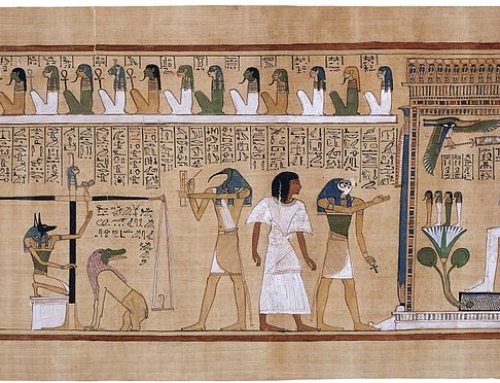
The ancient Egyptians showed that the god Anubis presides over the processes of death, both physical and internal. As head judge of karma, he receives the dead and judges them according to their deeds in life, whether good or bad. He does this along with the 42 judges of karma, and the god Thoth, who keeps record. This was depicted in ancient Egypt as the scene of the weighing of the heart, where at death a person has their heart weighed by Anubis on the scales of divine cosmic law.
In Greece Anubis became the god Hermes, and even merged to form the god Hermanubis, whilst in Rome he became the god Mercury. Both Hermes and Mercury were considered guides of the dead, and were depicted with winged sandals. Mercury was depicted holding a caduceus, symbol of alchemy with two serpents entwined around a winged staff, and Hermes with a winged cap. These are the wings of the spirit, which one receives after inner death upon resurrection. When the initiate is dead in the sarcophagus Anubis enters the door of the tomb wearing a headdress with the wings of mercury.
However, few experience firsthand Anubis’ role in presiding over inner death as few ever meet the requirements. It is Anubis who has the role in the spiritual dimensions to administer the initiate upon the stage of inner death preceding resurrection.
After Seth betrays, traps, and kills Osiris, and cuts his body into 14 symbolic pieces, Isis and Anpu/Anubis put the parts of Osiris back together. Osiris’ body is wrapped in linen swathing woven by the goddesses Isis and Nephthys, which will resist the influences of time and decay. This is symbolic of the creation of the alchemical spiritual bodies, the bodies of gold, formed by the divine mother from the purified sexual energies.
Joseph of Arimathea wraps the body of the crucified Jesus in linen before he places it in a tomb, like Anubis who conceals the body of the initiate in the tomb in order to bring it back to life.
The secret ways of Ro-Setawe [the ancient site of Giza], The gate of the gods. Only one whose voice is heard May pass them . . . The secret way to which (only) Anubis has access In order to conceal the body of Osiris.
~ The Book of the One in the Netherworld
As lord of karma, and head of the judges of divine cosmic law, Anubis stands as gatekeeper between the realm of earthly mortality, and spiritual imperishability, letting only those who meet the requirements pass.
Anubis, the counter of hearts, deducts Osiris N. from the gods who belong to the earth, (and assigns him) to the gods who are in heaven.
~ The Pyramid Texts utterance 577
The initiate must pass through Anubis, the guardian between the realm of earthly and spiritual existence, and the judge of karma, to attain immortal life.
Evidence has come to light that the sphinx may have been originally carved as Anubis in his recumbent pariah dog/jackal form and set down in a sacred lake, and was later reshaped by natural and man-made forces over many thousands of years (the Great Sphinx and Pyramids were built by the Atlanteans possibly around 10,500 BC or earlier). On the spring equinox, Anubis’ statue would have gazed directly at the rising sun on the spring equinox, preceded by the constellation in his same shape (which we today know as Leo). This would have symbolized the resurrection of Osiris with the help of Anubis, precisely at the time of the spring equinox, along with the symbol of the crucified Christ between the good and bad thief in the colors of the pyramids, as the most ancient enactment known of the attainment of eternal life.

An artist’s impression of what the Great Pyramids and Sphinx of Giza may have looked like when they were originally built. Note that the water surrounding the sphinx actually formed a sacred lake that would have submerged half of its body.
Death

The Hindu goddess Kali, symbol of the divine mother who destroys the egos of the initiate
Anubis, like Joseph of Arimathea, places the initiate into the tomb, which signifies a time of inner death.
Death in the spiritual work is an inner death—it is the death of the egos, the subconscious, the darkness of non-being, the myself, etc. within the human being, symbolized in the battles of the Hindu god Indra against Vritra. This death does not arrive inevitably as physical death does, but must be fought for, so that the spirit is freed, and totally dominates within, just as Indra frees the spiritual treasures contained within Vritra.
Osiris was placed in a tomb, just as Jesus is placed in a tomb. In the chambers of the Great Pyramids stone sarcophaguses were found (which are stone coffins) empty of burials—this is because they were never built for the bodies of the dead, but for the initiates of inner death. In order to resurrect, one has to reach a level of inner death in order to meet the required spiritual purity for attaining eternal life. This is the death of the various egos, such as anger, fear, pride, etc., which have been tested in the circumstances of the betrayal and passion.
However, even the Christ must die, in the sense of absorption into oneness, as symbolized by the death of Jesus, Quetzalcoatl, Osiris, etc. It is the divine mother in her warrior aspect (symbolized by the goddesses Durga, Kali, Coatlicue, Sekhmet, etc.) that has the role of killing the egos of the initiate. It is in her that the forces of life and death are found—she gave birth to the Son, and at death the Son returns to her.
The Return to the Womb
The process of enlightenment follows the process of creation in reverse, as it is a return to the source of creation. This is explained in How Enlightenment is the Process of Creation in Reverse.
In Egypt, creation is depicted as emerging as the god Atum as an island of fire from out of the primordial waters, and in Druidic myth from the cauldron of sap of the goddess Cariadwen. Similarly, creation emerges from the primordial waters in the ancient Vedas of the Hindus, in the story of Genesis in the Bible, and in Mesoamerican cultures. These primordial waters are those of the eternal feminine womb, the cosmic Mother, which gives birth to the sun, the fire, the Christ/Son, and the light of the first day in the universe from which all of creation unfolds. It is through this same process in reverse that the initiate with the Son within returns to the eternal spirit who conceived all of creation.

The Aztec Christ Quetzalcoatl being swallowed by the serpent (photo copyright wiki user Ptcamn)
To attain eternal life, the three forces of creation, which are Father, Mother, and Son, symbolized by the Father, Mary, and Jesus, must become one. The Son came from the womb of the mother, and so to return to the source, the Son must return to his divine Mother’s womb. But a return to the womb is also a time of death, as it is a return to the place which precedes birth. In Mesoamerica, this is symbolized by Quetzalcoatl being swallowed by the serpent, as the serpent is symbolic of the divine feminine (also known as Kundalini). Everything that is born must eventually die, and so even the Son must die symbolized by the deaths of Jesus, Osiris, Krishna, etc.
This return to the womb is symbolized by Jesus’ placement in a cave-like tomb, which no one had been placed in before—signifying the return to the womb of the ever-virginal divine Mother from whom the Son was born. In the Gospel of James, Jesus was also said to be born into a cave, which is a symbol of the womb, and his placement back inside a cave at his death completes the return to the womb.
In the story of Osiris, he is betrayed by Seth (just as Jesus was by Judas). Seth seals Osiris in a coffin, and then throws the coffin into the Nile River, symbolic of the Milky Way, which flows out to the sea—this is again symbolic of the return of the initiate to the womb of the divine Mother, the primordial waters of creation.
Hathor is perhaps the most prominent mother goddess of ancient Egypt, who was depicted as a cow, sometimes with a face shaped like a uterus to reflect her role of sacred birth. Both she and the goddess Nut were associated with the Milky Way, along with many other mother goddesses around the world—it is now known that at the center of the Milky Way is a birthplace of stars. Nut is depicted as stretching across the sky with a body of stars, giving birth to and then swallowing the sun in an eternal cycle of birth, death, and rebirth. Death for ancient Egyptians was a return to the womb by being swallowed by the goddess (just as the serpent swallows Quetzalcoatl).
Similarly, to the esoteric Neolithic people’s of Ireland, who built sacred sites like Newgrange around 3,500 BC, the Milky Way was known as “Bealach (or bother) an Bó Finne”, which means the way or the road of the white cow, and which they also associated with a river around which they built their sacred sites. In both their culture and the ancient Egyptians (as well as in ancient Hindu culture) the cow was a sacred symbol of the divine Mother, the eternal feminine.

A ceremonial Celtic cauldron found in Gunderstrup, Denmark (photo copyright wiki user Rosemania)
In Neolithic Ireland, as in Egypt, they also aligned their temples to the spring equinox using symbols of resurrection. Within the Eastern passage laid out in a cruciform shape of the temple mound of Knowth, there lies the Dagda Cauldron, symbol of the womb. In Irish myth the cauldron was believed to be a vessel of plenty – and it is said that no one ever left it hungry, and it never ran out. It is also said to have had the power to regenerate life so that dead bodies could be placed into the cauldron and drawn out alive and whole again. This is symbolic of resurrection. The symbol of the cross in the East chamber connects this part of the mound with the spring equinox, the time of Easter, thousands of years before it was symbolized again by Jesus.
The return to the womb is also found in the story of Jonah being swallowed by the whale/fish, where he spends 3 days and nights, just as Jesus did within the tomb. The Maize God Hun Hunahpu resurrects from a turtle, known as the tomb of the earth, which is another symbol of the womb.
The mound, cauldron, tomb, fish, turtle, and waters, are all symbols of the womb, which the initiate enters after their death at crucifixion. This is the return of the Son to the Mother, and it is in the Mother in which both the forces of death and birth are found.
The womb is the receptacle in which sexual activity takes place, and can therefore symbolize sexual activity itself, and activity in the alchemical mixing process. Therefore, the Son’s return to the womb also represents the initiate’s return to the work of alchemy, to work with the Mother in the processes of inner death and birth—which is the death of the egos (all that is material, and earthly), and the creation of the imperishability of the spirit (that which is everlasting). In returning to the womb, the initiate with the Son within works alchemically to transform themselves in order to resurrect. The initiate attains permanent Samadhi within themselves – from there they must die to their ego states with the help of the Mother to attain the Tality within at resurrection.
[Jesus] Destroy this temple, and I will raise it again in three days.
~ John 2:19
Sexual Symbols

A tall stone and round stone at the Neolithic temple mound Knowth, symbolic of the male and female sexual organs
In the churning of the milky ocean, the ocean represents the milky way, but also the sexual waters/energies, which the initiate must control so that the spiritual faculties and the elixir of immortality emerge. They must struggle between the pull of sexual desire as the demons on one side, and that of the spirit, symbolized as the devas, on the other. The demons and devas pull back and forth on a giant serpent, which is also a symbol of the sexual energies, as the Kundalini. Jesus, crucified on a cross, which is a sexual symbol, is stretched with his arms across it to a point that is excruciating, signifying the painful struggle between desire and the spirit.
When Krishna is killed, he is ritually bathing himself in the water of the river Ganges, which is symbolic of the purification of the sexual energies. Seth cuts Osiris’ body into 14 pieces, 13 of which the goddess Isis finds. 13 is the symbolic number of death, which represents the inner death of the initiate. The 14th piece of Osiris, which is swallowed by a fish, is his phallus, so Isis fashions a phallus of gold. 14 is the number of alchemical transmutation, and the gold phallus represents the transformation of the sexual energies into the gold of the spirit.
The Lance of Longinus, which pierced the side of Jesus while he was on the cross, and the Holy Grail used at the last supper and which caught the blood of Jesus from the wound made by the lance, are both sexual symbols. The lance is the male phallus, and the grail the feminine uterus. The wine and blood of Christ are the purified sexual energies. These symbols are also found at the Neolithic temple mound Knowth, which incorporated the symbol of the cross at the time of the spring equinox thousands of years before Jesus. Outside the mound is a tall stone beside a short rounded one, representing the male and female sexual organs.
The Holy Grail became the subject of the esoteric teaching encoded in Arthurian legends, in which the knights of Arthur’s round table quested for this sacred relic. In the story, Lancelot is unable to enter the chapel of the grail because he was an adulterer, revealing the sexual purity needed in the spiritual work. It is only Galahad who had the purity required, and upon beholding the grail was made complete and taken up to heaven.
The Elixir of Immortality and the Bodies of Gold

Sir Galahad receiving the Holy Grail
The Holy Grail, like the symbol of the cauldron of the Neolithic builders of Ireland, is a symbol of the female sexual organs. It is within sex that the wine of the alchemist is transformed from its impure leaden state, to the gold of the spirit.
This transformed sexual energy has been called Amrita and Soma in ancient Hindu texts, and Ambrosia in the Eleusinian mysteries of ancient Greece. It is the “drink of the gods”, the elixir of immortality. In the ancient Hindu story of the churning of the milky ocean, this Amrita is produced by the struggle between the demons and devas—which are symbolic of the struggles between the forces of sexual desire on one hand (the bad thief) and the bliss of the spirit (the good thief) on the other. It is in this struggle that the sexual energies are purified.
The demons in the story try to steal the elixir of immortality, symbolizing the bad thief of sexual desire that tries to steal the sexual energies for pleasure. However, through the help of the god Vishnu, the devas instead gain possession of the elixir. The devas are symbolic of the good thief who takes the sexual energies and uses them to create the bliss and imperishable bodies of the spirit. The god Indra who is also present, drinks this elixir, and in doing so, is able to ascend to heaven, just as Galahad did in the presence of the Holy Grail.
The god Indra is symbolic of the initiate with the Son within—he continuously fights Vritra, represented as a dragon that contains the life sustaining treasures of the universe (the waters, light, and cows) which Indra must conquer back, as well as the asuras (demons). This is the fight to rescue consciousness from the darkness of the subconscious (chaos and non-being), which is done in alchemy. Indra symbolically drinks Soma, the purified sexual energies, to give himself the strength he needs in battle—and finally defeats the asuras (the demons of the churning of the milky ocean). This Soma gives him the body of gold he is depicted with.
In Indra are set fast all forms of golden hue.
~ The Atharva Veda

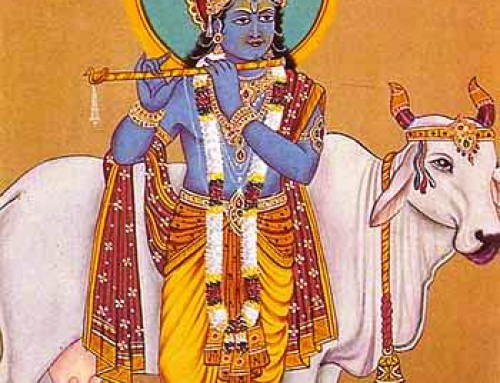
Krishna with a golden halo, and standing by a white cow, symbol of the divine mother who works with the initiate to create the golden bodies
In ancient Egypt, the gods are also said to possess the body of gold, which is an imperishable body of the spirit.
The body of the dead is of gold like that of a god and so it consists of imperishable material. ‘Rise on your bones of bronze and on your limbs of gold, for this body of yours belongs to a god. It does not perish. It does not decompose, it does not consume.’
~ The Pyramid Texts
This body of gold is also symbolized by the halo, which Jesus and Krishna are both depicted with. The bodies of gold are the bodies of the Son, formed within by the purification of the sexual energies. These are the imperishable bodies which continue as the vessels of the initiate in the spiritual realm, whilst the physical body dies and decays. Those without these golden bodies do not have the vehicles to enter the spiritual realms, and instead go to the realm of the dead.
Heaven is not the wide blue sky but the place where corporeality is begotten in the house of the Creative. If one keeps this up for a long time there develops quite naturally, in addition to the body, yet another spirit-body.
~ The Secret of the Golden Flower (ancient Taoist text)We have drunk Soma and become immortal; we have attained the light, the Gods discovered. Now what may foeman’s malice do to harm us? What, O Immortal, mortal man’s deception?
~ The Rigveda 8.48.3
The Annunciation

The scene of the impregnation of Isis at the temple of Dendera in Egypt. Although badly damaged, one can make out Osiris lying dead, with Isis above his phallus in the form of a bird. Anubis stands over Osiris, with Horus behind him. Nephthys is kneeling in lamentation on the right.
The time of the spring equinox stands on the point of balance. On one side are all the forces of darkness, death, and decay. On the other are the forces of birth, life, and growth. As depicted in the churning of the milky ocean, the spring equinox is the point of rotation, and this point of rotation is found within the womb of the divine Mother goddess.
It is from the womb that all life is born, and it is to the womb that all life returns to at death. Thus, the spring equinox is not only the time of the death of the Son, but also of his first conception. In the life of Osiris, Isis becomes pregnant to Osiris at the time of his death by hovering over him in the form of a bird—signifying sex of the spirit. It is from this miraculous, virginal conception that Horus (Twice Great God and Lord of Heaven), will be born at the winter solstice.
In Germany the goddess Eostre mated with the solar god on the spring equinox and gave birth to a child at the winter solstice. Eostre eventually became the word for Easter, the time when Mary becomes pregnant with Jesus, who is also born 9 months later at Christmas, the time of the winter solstice.
Isis, Eostre, and Mary, symbolic of the divine Mother, remain ever virgin. Their impregnation is the annunciation which is symbolic of the first act of creation in the universe and of the spiritual within a person. In ancient Persia, the spring equinox is celebrated as the day when the universe first began its motion. This first act of creation, the impregnation, is a sexual one, and why both celebrations of fertility and rites of sacred sexuality were practiced by different cultures at the time of spring equinox. At the right time while symbolically lying in the tomb, the initiate resumes sexual alchemy.
The initiate must go beyond the continuous cycle of death and birth found in the Mother to attain the imperishable—and go beyond good and evil, and the concepts of morality. To do this they must pass through the darkness and chaos of the primordial waters.
The Descent into Hell
The return to the womb is also to enter into the primordial chaos, into darkness, and the abyss. During the symbolic 3 days in the tomb, Jesus descends into hell. This is the descent of the initiate into hellish psychological regions in which they have to face sufferings such as those found in hell itself, and work with the Mother in the inner death of the egos.
[Jesus] For as Jonah was three days and three nights in the belly of a huge fish, so the Son of Man will be three days and three nights in the heart of the earth.
~ Matthew 12:40

Jesus enters hell
The East-West axis of the temple of Angkor Wat is offset to give a 3 day anticipation of the spring equinox. This is the symbolic 3 day time preceding the resurrection in which the nights still have dominion over the days.
All sacred teachings throughout the world speak of an underworld. It is the place people go to who have not attained immortality to undergo the process of the death and decay of their own psychological defects, the egos. Either the Mother works with the initiate in the underworld to destroy the egos in the spiritual work, or the Mother destroys them in the underworld as the person suffers the consequences of their egos after death. To the ancient Egyptians it was the place of the evil dead called the Place of Annihilation. To the Mayans it was Xibalba, meaning Place of Fright. The Hindus and Buddhists call it Naraka. In Christianity it is Hell, and in Greek mythology it is Hades, etc.
At the temple of Chichen Itza in Mexico, the feathered serpent Quetzalcoatl, the Son, ascends the 9 terraces of the pyramid in a display of light created by the movement of the spring equinox sun. The Mayans knew that the underworld had 9 layers, just as Dante described in his esoteric work The Divine Comedy. This symbolizes the ascent of the unified Mother-Son, Quetzalcoatl swallowed by the serpent, from out of the underworld to resurrect.
Similarly, the temple of the grand jaguar in Tikal has 9 terraces to its pyramid, which the spring equinox sun ascends, and in doing so causes the temple to cast a perfect shadow over the nearby temple of the moon. This is the ascent of the sun from out of the underworld, with the jaguar (symbol of the warrior Son who fights evil) and the moon (symbol of the Mother) as one in the conjunction of the shadows of the temples.
The number 9 is also symbolic of the 9th sphere, which is the work of sexual alchemy. It is also through the work in alchemy, the work of inner death and birth, that one ascends. The ascent out of the underworld in order to resurrect is a long and difficult climb.
Resurrection

The feathered serpent at the ancient pyramids of Teotihuacán in Mexico (photo copyright Jami Dwyer)
Resurrection is the attainment of eternal life, immortality, and imperishability mentioned in ancient esoteric Christian and Egyptian texts and celebrated at the time of the spring equinox.
An ancient Taoist text wisely states that those who wish to reach eternal life must look for the place where creation originally came from:
Whoever seeks eternal life must search for the place whence human nature and life originally sprang.
~ The Secret of the Golden Flower
Life and creation originally sprang from the eternal divine spirit as described in creation stories throughout the ancient world. That which is eternal, is that which never dies – and only that which is never born does not die. In the beginning of creation the spirit of the Father impregnates the Mother, and this spirit is everlasting – existing beyond birth and death. Attaining eternal life is a return to this everlasting spirit.
I have been united to Him, for the Lover has found the Beloved, And because I shall love Him that is the Son, I shall become a son; For he that is joined to Him that is immortal, will also himself become immortal; And he who has pleasure in the Living One, will become living.
~ The Odes of Solomon
Resurrection is the process of becoming a feathered serpent, symbolized in Mesoamerican cultures. The god Quetzalcoatl is the Son; the serpent is a symbol of the Mother; and the feathers symbolic of the Father—it is from the union of Father, Mother, and Son, that Quetzalcoatl becomes the feathered serpent. To become a feathered serpent the initiate firstly becomes a Son. Then, the Mother absorbs the Son. This is to return to the womb of creation, the origin of all birth and death, symbolized as the death and laying in the tomb after crucifixion. To resurrect, the united Mother and Son returns to the Father—the imperishable source of all life.
At resurrection, the initiate drinks the nectar of immortality from the Holy Grail, the drink of the gods, and like Galahad, is made complete.
To achieve full self-realization an initiate must return to the source of creation, the Absolute, where all is one. To do that the different parts of the Being that were divided in creation must unite to form one whole, as it is not possible to enter the Absolute divided; we must return as one as we left, but with self-consciousness from the experience of existence in matter. When the three forces of creation – Father, Mother and Son – are one and have returned to the divine source, the initiate has gone through the process of creation in reverse and re-absorbed the principles of life and divinity.
It is by love, that the Heavenly Father and the Earthly Mother and the Son of Man become one. For the spirit of the Son of Man was created from the spirit of the Heaven Father, and his body from the body of the Earthly Mother. Become, therefore, perfect as the spirit of your Heavenly Father and the body of your Earthly Mother are perfect.
~ The Essene Gospel of Peace
Whilst the evil of the world celebrated the death of the Son, as Jesus, Osiris, Krishna, etc., it is the Son who truly triumphs in the defeat of darkness within the initiate and in his resurrection, symbolized by the rising of the spring equinox sun. Although the passion and death of the Son is a tale of human tragedy, the darkness of death and winter has its role in the cycles of life in the universe and in the process of self-realization – and that darkness is overcome by light at the spring equinox and by resurrection of the individual.
The work from here is that to now return to the source of creation, known as the ascension and symbolized at the summer solstice.
To say: It is beautiful to see, it is peaceful to hear that Osiris stands at the door of the gods.
Thy sanctuary, N. [the initiate], is to thee as a heart of secret places;
it opens for thee the double doors of heaven, it opens for thee the double doors of the way;
it makes for thee a way, that thou mayest enter there among the gods, that thou mayest live as thy soul.
O N., thou art not like the dead, who art dead,
thou art living, thou art alive, together with them, the spirits, the imperishable stars.
~ The Pyramid Texts utterance 667Oh Osiris the King, you have gone, but you will return. You have slept, but you will awake. You have died, but you will live. The tomb is open for you. The doors of the coffin are drawn back for you. The doors of the sky are thrown open for you.
~ The Pyramid Texts
~ Copyright 2012 Belsebuub and Angela Pritchard
More on the Spring Equinox
Ancient Sacred Sites Aligned to the Spring Equinox
A Ceremony to Celebrate the Spring Equinox